Return to sport after a Covid-19 infection

26th Apr, 2021

After being swamped with news regarding Covid-19 for the past 2 years, it is known that the symptoms of Covid-19 infection include shortness of breath, dry cough, fever, etc. However, you may not be aware that even after recovering from a Covid-19 infection, you are at risk of:

  1. Cardiological, pulmonary and haematological complications due to the infection
  2. Orthopaedic injuries due to prolonged rest and a sudden increase in loads when attempting to return to sport

Hence, caution is recommended when resuming physical activity after a Covid-19 infection.

To begin, you should meet the following criteria before proceeding with a graduated return to play plan:

  • 10 days of rest and 7 days symptom-free
  • No longer under treatment/medication
  • Able to complete activities of daily living and walk 500m on flat ground without excessive fatigue or breathlessness

Thereafter, you may consider using this graduated return to play protocol (GRTP).
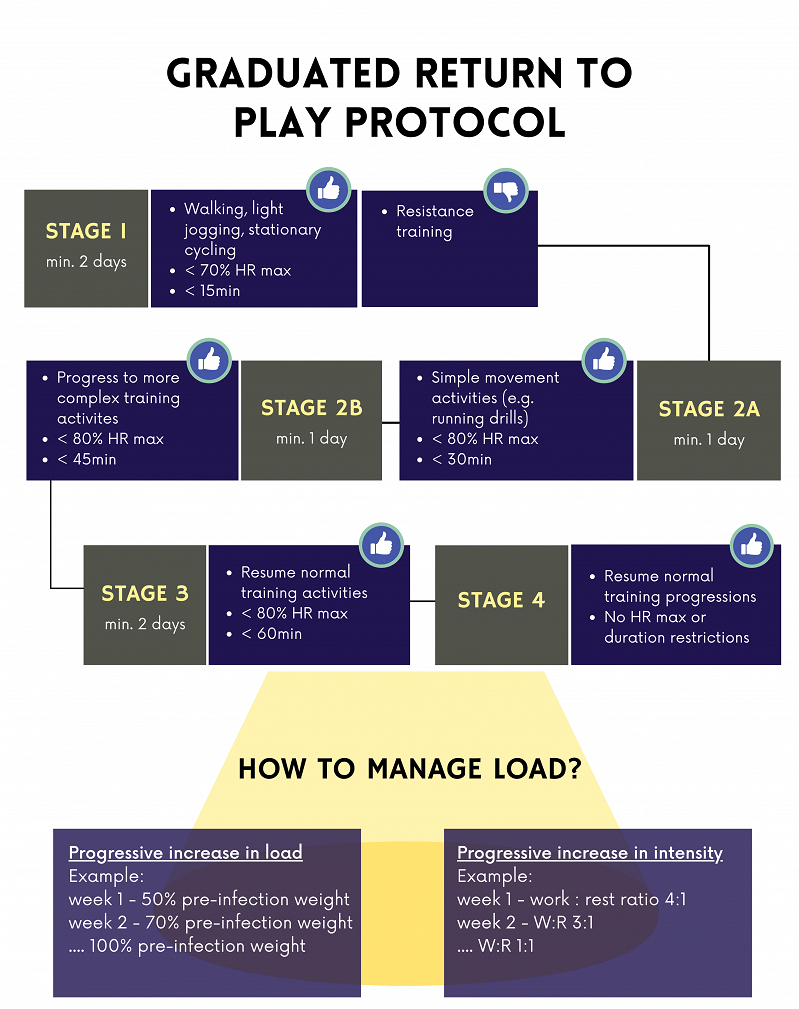
Gradually increasing the level of physical exertion during the first few days are crucial to ensure that your body has fully restored its ability to cope with high cardiopulmonary demands. During this period, it is recommended that you monitor the following:

  • Resting heart rate
  • Rate of perceived exertion
  • Sleep, stress, fatigue and muscle soreness
  • Psychological Readiness to Return to Sport (PRRS)

Should there be a significant increase in any of the above 4 measures, you should return to the previous stage and progress again after 24 hours of rest without any of these symptoms.

On the other hand, the progressive increases in load and intensity are critical in preventing musculoskeletal injuries. A period of rest allows for detraining. This means that your muscles and tendons may have reduced their load capacity, depending on the duration of your recovery. Since orthopaedic injuries are often caused by loading these structures beyond their load capacity, re-starting training with a reduced load and working your way up is the safest way to return to your pre-infection performance.

DISCLAIMER: The advice given in this article applies to people who have suffered from mild to moderate Covid-19 symptoms. If you have suffered from severe or prolonged Covid-19 symptoms, or have other comorbidities (e.g. diabetes, cardiovascular disease, etc), please consult your doctor for further medical assessment.

References:

Elliott N, Martin R, Heron N, et alInfographic. Graduated return to play guidance following COVID-19 infection British Journal of Sports Medicine 2020;54:1174-1175.

Caterisano, Anthony Co-Chair1; Decker, Donald Co-Chair2; Snyder, Ben Co-Chair1; Feigenbaum, Matt1; Glass, Rob3; House, Paul4; Sharp, Carwyn5; Waller, Michael6; Witherspoon, Zach2 CSCCa and NSCA Joint Consensus Guidelines for Transition Periods: Safe Return to Training Following Inactivity, Strength and Conditioning Journal: June 2019 – Volume 41 – Issue 3 – p 1-23 doi: 10.1519/SSC.0000000000000477

Filed under: COVID-19
Share Post:

Categories

[blog_categories]

Latest Posts

How to Return to Running Safely

How to Return to Running Safely

The first run back after injury often feels like a test. You lace up, tell yourself to take it easy, then spend the whole session wondering whether every twinge means you have done too much. If you are trying to work out how to return to running safely, that...

Tennis Elbow Physiotherapy That Works

Tennis Elbow Physiotherapy That Works

That sharp pull on the outside of your elbow often shows up during ordinary tasks before sport does - lifting a kettle, gripping a mouse, carrying shopping, or shaking someone’s hand. Tennis elbow physiotherapy is not really about chasing pain with quick fixes. Done...

A Guide to Meniscus Surgery Recovery

A Guide to Meniscus Surgery Recovery

The first few days after knee surgery can feel deceptively simple. The stitches are small, the pain may be manageable, and many people assume the hard part is over. In reality, a good guide to meniscus surgery recovery starts here - not with rest alone, but with the...

Hip Pain Physiotherapy That Actually Helps

Hip Pain Physiotherapy That Actually Helps

That sharp pinch getting out of a chair, the ache on a long walk, the stiffness after a run - hip pain has a way of shrinking daily life. Good hip pain physiotherapy is not about chasing symptoms with a few stretches or a quick massage. It is about working out why the...

How to Recover After ACL Surgery

How to Recover After ACL Surgery

The first few weeks after ACL reconstruction can feel oddly contradictory. Your knee may look better than you expected, yet simple things like walking, sleeping comfortably or getting up from a chair can feel far harder than they should. If you are wondering how to...

Can Physiotherapy Help a Slipped Disc?

Can Physiotherapy Help a Slipped Disc?

That sharp pain down the leg, the sudden difficulty standing upright, the fear of bending to pick something up - a slipped disc can make ordinary movement feel risky. If you are wondering can physiotherapy help slipped disc symptoms, the short answer is yes, in many...

Knee Pain After Running: What It Means

Knee Pain After Running: What It Means

A sore knee after a run can feel deceptively simple. You finish, cool down, and only then notice an ache around the kneecap, a sharp twinge on the outside of the knee, or stiffness that appears when you sit down later. Knee pain after running is common, but it is not...

Guide to Rotator Cuff Rehabilitation

Guide to Rotator Cuff Rehabilitation

Shoulder pain has a way of getting into everything. Reaching for a seatbelt, lifting a child, swimming, pressing overhead at the gym, even finding a comfortable sleeping position can suddenly feel uncertain. A good guide to rotator cuff rehabilitation should do more...

Lower Back Pain Physio Treatment That Works

Lower Back Pain Physio Treatment That Works

Lower back pain has a way of shrinking life. Sitting through a work meeting becomes distracting, lifting your child feels risky, and even a decent night’s sleep can turn into a negotiation with your spine. Good lower back pain physio treatment is not about chasing a...

Shoulder Pain Rehabilitation Programme Guide

Shoulder Pain Rehabilitation Programme Guide

Reaching for a seatbelt, lifting a child, pressing overhead at the gym, even finding a comfortable sleeping position - shoulder pain has a way of turning ordinary movements into a daily reminder that something is not right. A good shoulder pain rehabilitation...

Verified by MonsterInsights