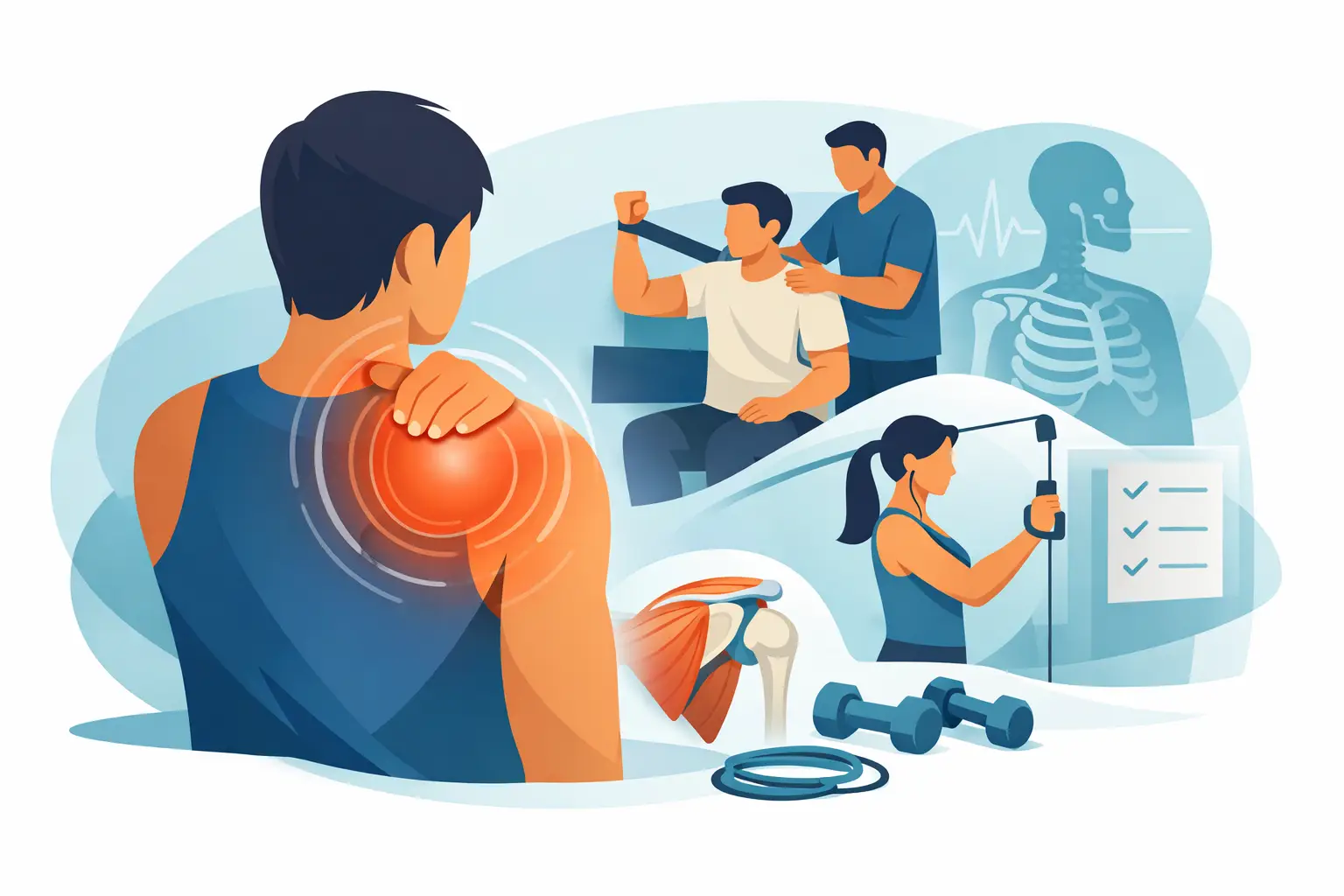
Reaching for a seatbelt, lifting a child, pressing overhead at the gym, even finding a comfortable sleeping position – shoulder pain has a way of turning ordinary movements into a daily reminder that something is not right. A good shoulder pain rehabilitation programme is not about chasing pain down with quick fixes. It is about understanding why the shoulder is irritated, what the tissue can currently tolerate, and how to rebuild movement, strength and confidence step by step.
That matters because shoulder pain is rarely solved by rest alone. Research in the British Journal of Sports Medicine and Journal of Orthopaedic & Sports Physical Therapy has consistently supported active, exercise-based rehabilitation for many common shoulder problems, particularly rotator cuff-related shoulder pain. Passive treatment can help in the right context, but it should not be the whole plan. The shoulder usually gets better when the right structures are loaded in the right way, at the right time.
What a shoulder pain rehabilitation programme should actually do
The shoulder is not one joint behaving in isolation. It is a system involving the glenohumeral joint, shoulder blade, thoracic spine, ribcage and the muscles that coordinate them. That is one reason generic online routines often disappoint. Two people can both say, “my shoulder hurts when I lift my arm”, yet one may have an irritable rotator cuff, another may be stiff after surgery, and another may be dealing with neck-related pain referring into the shoulder.
An effective programme should do three things. First, settle symptoms enough that daily life feels manageable. Secondly, restore mobility, strength and control where they are missing. Thirdly, prepare the person for the exact tasks that matter to them, whether that is swimming, carrying shopping, returning to tennis or simply sleeping through the night.
This is also where expectations matter. Pain reduction is often the first goal, but not the only one. If pain improves while strength, endurance and movement quality remain poor, flare-ups are far more likely when life becomes busy again.
Why shoulder pain needs an individual assessment
A principled rehabilitation approach starts with assessment, not assumptions. Clinically, shoulder pain can stem from rotator cuff-related pain, frozen shoulder, instability, acromioclavicular joint irritation, labral injury, post-operative stiffness, tendon overload or referred pain from the neck. The same exercise can help one presentation and aggravate another.
A thorough assessment looks at symptom behaviour, injury history, training load, work demands, sleeping patterns, mobility, strength and function. It should also identify red flags and recognise when imaging or onward referral may be appropriate. Evidence-based physiotherapy does not mean every painful shoulder needs a scan. In many cases, symptoms and function guide treatment more usefully than imaging findings alone, especially as structural changes can exist in people with no pain at all.
For active people, another key question is dosage. How much is too much, too soon? JOSPT and sports medicine literature repeatedly show that load management is central to tendon and muscle rehabilitation. Complete rest can reduce symptoms temporarily, but underloading for too long leaves the shoulder deconditioned. On the other hand, pushing into high-volume training before the tissue is ready often keeps the cycle going.
The phases of a shoulder pain rehabilitation programme
Most shoulder rehabilitation follows phases, although the exact timeline depends on the diagnosis, irritability and the person’s goals.
Phase 1 – Calm the shoulder without shutting life down
When pain is easily provoked, the first priority is to reduce irritation while keeping the shoulder engaged. This may involve temporary changes to gym training, overhead work, throwing volume or sleeping position. The aim is not to avoid movement altogether, but to find movements that the shoulder can tolerate.
Early exercises often include gentle isometrics, supported range-of-motion work and simple scapular control drills. For some patients, isometric external rotation or abduction work can reduce pain enough to allow better movement. For others, especially after surgery or with significant stiffness, the emphasis may be on regaining motion first.
Pain science is useful here. Hurt does not always equal harm, and a mild increase in symptoms during exercise is not automatically a setback. But there is a difference between acceptable exercise discomfort and a flare that lasts well into the next day. Good programming respects that line.
Phase 2 – Restore movement and basic strength
Once symptoms are more settled, the programme should become more progressive. This is where many people improve initially and then plateau because the plan never moves beyond bands and light mobility work.
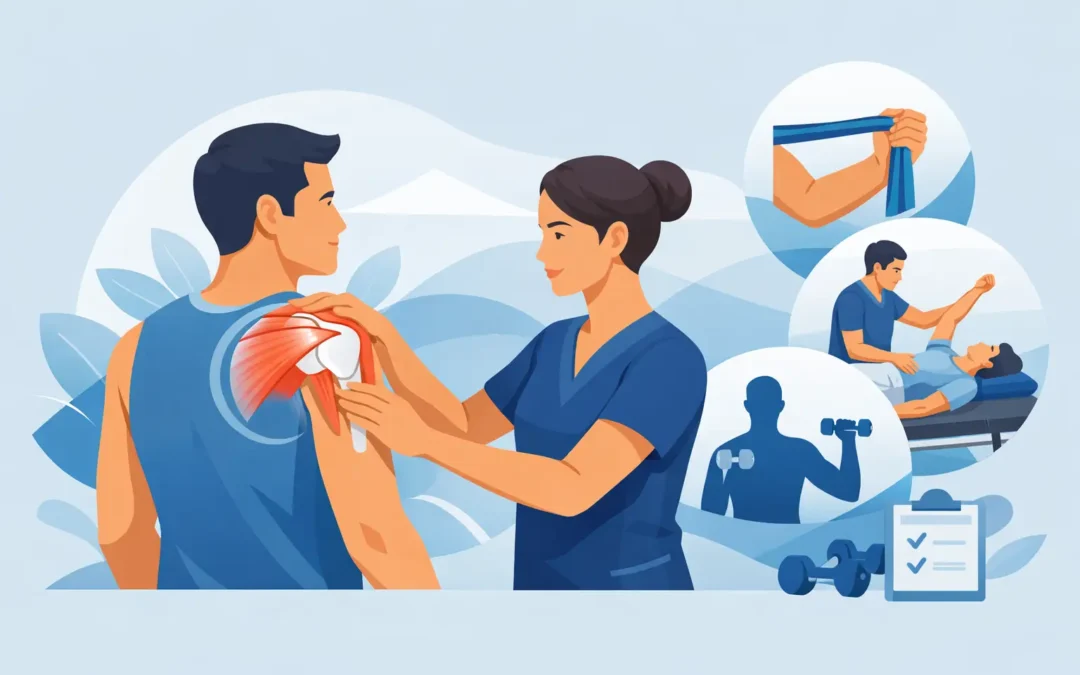
The evidence strongly supports progressive exercise for many shoulder conditions. Depending on the presentation, this may include rotator cuff loading, shoulder blade strengthening, thoracic mobility work and gradual exposure to overhead movement. Exercises such as external rotation, scaption, rows, presses, carries and controlled elevation patterns can all have a place, but only if they match the person’s impairments and goals.
Technique matters, but not in a rigid, perfectionist sense. There is no single ideal way every shoulder must move. What matters more is whether the person can complete the task with appropriate control, tolerable symptoms and suitable load.
Phase 3 – Build capacity for real life and sport
This is the phase that often determines whether results last. Daily life and sport demand more than pain-free arm raises in a clinic room. They require repeated effort, speed, endurance and confidence.
For office workers, that may mean tolerating long hours at a desk without escalating symptoms. For parents, it may mean repeated lifting and carrying. For gym-goers, it may mean pressing, pulling and hanging loads. For athletes, it may involve high-speed overhead work, contact, or return-to-throwing progressions.
BJSM and sports rehab literature support the principle of sport-specific and task-specific loading before full return. In simple terms, if your goal is to serve in tennis or snatch a barbell overhead, your shoulder pain rehabilitation programme should eventually prepare you for exactly that. General strengthening is necessary, but it is not the finish line.
What treatment should and should not look like
Patients are often told they need massage, machines or endless passive treatment to “release” the shoulder. These can have a short-term role for some people, particularly to ease symptoms or support movement early on, but they are not the engine of recovery.
The most reliable long-term change usually comes from a blend of education, graded exercise, load management and progression based on function. That is especially true for persistent or recurrent shoulder pain. A patient-first physiotherapy plan should explain what is being treated, why each stage matters, and what progress markers to expect.
There are trade-offs. In very irritable cases, pushing strength too early can provoke pain. In stiff shoulders, chasing heavy loading before movement improves may be frustrating and unproductive. After surgery, timelines and precautions matter. This is why off-the-shelf programmes are limited. Good rehabilitation is not vague, but it is flexible.
How long does shoulder rehabilitation take?
This depends on the problem. A mild overload issue may improve significantly within weeks. Rotator cuff-related pain often needs a longer progression, especially if strength deficits and deconditioning have built up over months. Frozen shoulder can be slower and more unpredictable. Post-operative rehabilitation may follow a staged protocol over several months.
The useful question is not only “how long until pain goes away?” but “how long until the shoulder can handle what I need from it?” Those are not always the same thing. A person may feel much better at six weeks yet still lack the strength and endurance required for full sport or heavy lifting.
Progress should be measured in more than pain scores. Range of motion, strength, work tolerance, sleep, confidence and return to activity all matter. Rehabilitation is doing its job when your shoulder becomes more capable, not just quieter.
When to seek help for a shoulder pain rehabilitation programme
If shoulder pain has lasted more than a couple of weeks, keeps returning, disturbs sleep, limits work or training, or followed a traumatic injury, it is worth getting assessed. The same applies if you feel weak, unstable, or unable to progress despite resting.
A detailed physiotherapy assessment can help distinguish between issues that need modified loading, those that need more specific strengthening, and those that may need medical review. It can also stop the common cycle of doing too little for too long, then trying too much in one go.
At its best, physiotherapy is not passive. It is a guided process that helps you understand your shoulder, rebuild capacity and return to function with more confidence than before. That takes diligence from both clinician and patient, but the payoff is meaningful – not just less pain, but a shoulder you can trust again.
If you are dealing with shoulder pain in Singapore and want a plan built around your actual goals, not a generic sheet of exercises, the right support can make the process far clearer. Ready to take the next step in your recovery? Book a session with our team at PhysioX today.
Recovery tends to move best when the plan makes sense, the exercises are specific, and you know what you are working towards.