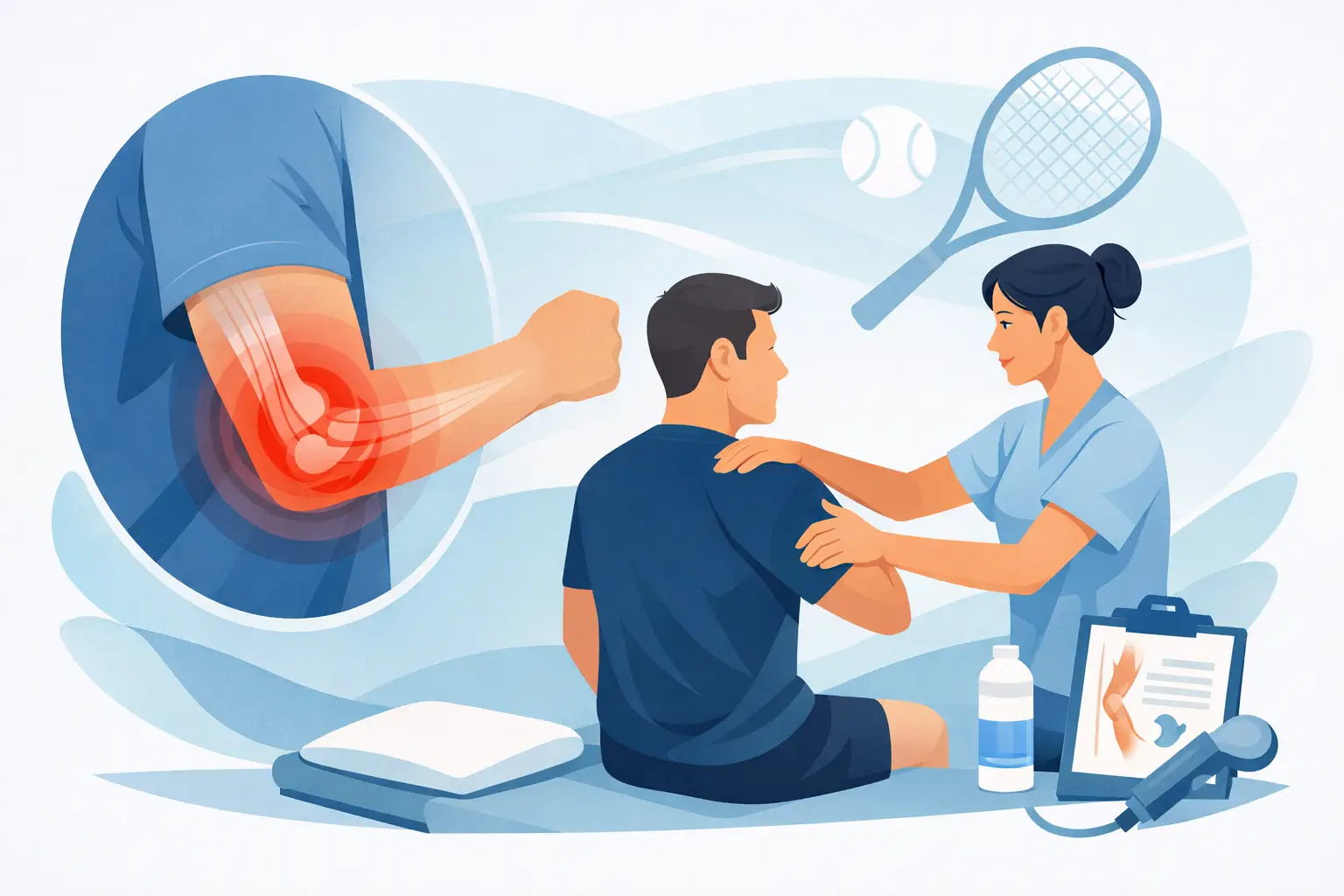
That sharp pull on the outside of your elbow often shows up during ordinary tasks before sport does – lifting a kettle, gripping a mouse, carrying shopping, or shaking someone’s hand. Tennis elbow physiotherapy is not really about chasing pain with quick fixes. Done properly, it is about understanding why the tendon has become irritated, what is still safe to do, and how to rebuild your arm’s capacity so daily life feels normal again.
Despite the name, tennis elbow does not just affect tennis players. In clinic, it is common among desk-based workers, gym-goers, parents lifting children, tradespeople, and anyone doing repeated gripping or wrist extension. The clinical term is lateral elbow tendinopathy. In simple terms, the tendon on the outside of the elbow becomes overloaded and starts reacting to more force than it can currently tolerate.
What tennis elbow physiotherapy is really trying to fix
Many people assume the answer is rest until the pain disappears. That can help settle a flare-up in the short term, but complete rest rarely restores the tendon’s ability to cope with real life. Evidence from sports medicine and tendinopathy research consistently points towards a more active approach. Tendons generally respond best when load is adjusted rather than removed completely.
That matters because pain is only part of the picture. With tennis elbow, the bigger issue is often reduced load tolerance. You may be able to move the elbow, but gripping, lifting or twisting can feel weak, sharp or unreliable. Good physiotherapy looks beyond the sore spot itself. It asks what has changed in your training, work setup, recovery habits, upper limb strength and movement patterns that may have pushed the tendon past its current limit.
In practice, this is why ethical physiotherapy should not revolve around massage, ultrasound, or passive treatment alone. Those approaches may provide short-lived symptom relief for some people, but they do not reliably build tendon capacity. If your goal is lasting change, treatment needs to include progressive rehabilitation.
Tennis elbow physiotherapy assessment matters more than people think
Not every outer elbow pain problem is classic tennis elbow. A proper assessment helps rule out other contributors such as referred pain from the neck, radial tunnel irritation, joint-related pain, or combined shoulder and wrist issues. This is especially important if symptoms are severe, have lasted for months, or are not responding in the usual way.
A physiotherapist will usually ask about pain triggers, training load, work demands, hand dominance, sleep, and how long the condition has been present. They will also test grip strength, resisted wrist and finger extension, elbow movement, and nearby areas including the shoulder and neck. Research published across journals such as the British Journal of Sports Medicine and the Journal of Orthopaedic & Sports Physical Therapy supports this broader, function-led assessment model. The reason is simple – local pain is often influenced by what the whole limb is doing.
This detailed assessment also helps set expectations. Some cases settle within weeks. Others, especially persistent tendinopathy, take longer and improve in stages rather than in a straight line. That does not mean recovery is failing. It means the programme needs to match the tendon’s current irritability and your real-life demands.
What treatment usually involves
The strongest evidence supports exercise-based rehabilitation as the core of treatment. That does not mean random stretching from the internet. It means a structured programme that progresses over time.
Early on, the aim is often to reduce aggravation without making the elbow overly protected. This may include temporarily modifying activities that spike pain, such as heavy gripping, repeated backhand practice, awkward keyboard positions, or high-volume lifting. Some people benefit from isometric loading at first. These are static muscle contractions that can help settle symptoms while keeping the tendon engaged.
As pain becomes more manageable, rehabilitation usually shifts towards isotonic strengthening. This often targets the wrist extensors, forearm, grip, and then the wider chain – shoulder, scapular muscles and sometimes trunk control. That wider approach is not overcomplicating things. If the shoulder lacks control or the forearm is asked to do more than it should, the elbow often pays the price.
Progressive loading is central here. BJSM and JOSPT literature on tendinopathy management repeatedly supports graded resistance exercise as a key principle. The tendon needs an appropriate stimulus to adapt. Too little, and capacity does not improve. Too much, and symptoms flare. Good physiotherapy helps you find that middle ground.
Manual therapy may still have a place, but as an adjunct rather than the main event. Some patients feel short-term relief from hands-on treatment, joint mobilisation, or soft tissue work. Used well, these can help create a window for better movement and exercise. Used in isolation, they are rarely enough.
Bracing can also help selected cases, especially during tasks that cannot be avoided. But a strap is a tool, not a cure. The same goes for taping. If it makes the arm more comfortable for a period, that can be useful. It should not replace the work of rebuilding strength and tolerance.
What recovery actually looks like
One of the most frustrating parts of tennis elbow is that everyday tasks can remain sore even when the elbow seems better at rest. This is why symptom tracking should be practical. Rather than asking only, “Does it hurt?”, better questions are, “Can I grip more strongly? Can I carry a bag? Can I work at my desk longer? Can I return to the gym without a flare-up the next day?”
A sensible rehabilitation plan usually allows some tolerable discomfort during exercise, provided symptoms settle afterwards and are not progressively worsening. That point often reassures people. Pain during rehab is not always a sign of damage. Current pain science and tendon research suggest that acceptable, monitored loading can be part of recovery.
That said, it depends on irritability. If your elbow is highly reactive and daily tasks are sharply painful, the programme should start more gently. If symptoms are milder and stable, progression can be faster. This is why generic online exercises often disappoint. The right exercise at the wrong stage is still the wrong exercise.
What tends to slow progress
The biggest issue is often not a lack of effort, but effort aimed in the wrong direction. People commonly stretch aggressively, keep testing the pain with repeated gripping, or stop and start exercises without consistency. Others continue all aggravating activities unchanged and hope the elbow will somehow settle around them.
Another common problem is focusing only on the elbow. For racquet sport athletes, technique, equipment, training volume and recovery all matter. For office workers in Singapore spending long hours at a laptop, sustained mouse use, poor arm support and high cumulative load can keep the tendon irritated. For gym-goers, sudden jumps in pulling volume or gripping-heavy exercises may be the trigger.
Sleep, general stress and recovery also influence pain sensitivity and healing. Good physiotherapy should acknowledge that without making the condition sound mysterious or overwhelming.
When to seek help
If elbow pain has lasted more than a few weeks, is affecting work or training, or keeps returning whenever you try to resume normal activity, it is worth having it assessed. Early guidance can stop a reactive problem becoming a stubborn one.
You should also seek review if there is significant weakness, altered sensation, pain spreading far beyond the elbow, or if the diagnosis is unclear. Not all elbow pain is tendon pain, and accuracy matters.
For people who have already tried rest, massage or supports without meaningful change, that is often a sign the missing piece is a more precise rehabilitation plan. A one-to-one physiotherapy approach can help identify the true drivers, build confidence with loading, and make your progress measurable rather than guesswork.
The encouraging part is that most people do improve with a well-structured, evidence-based programme. Tendons can adapt. Strength can come back. Grip can feel dependable again. But lasting change usually comes from doing the right work consistently, not from waiting for the pain to disappear on its own.
If your elbow is stopping you from training, working, or simply getting through the day comfortably, you do not need to keep second-guessing it. Ready to take the next step in your recovery? Book a session with our team at PhysioX today.
Recovery is rarely about doing more. More often, it is about doing what matters, at the right time, with a plan you understand and can trust.