Is your Achilles tendon your Achilles’ heel (no pun intended)?😏
The Achilles tendon (AT) is the thickest and strongest tendon in the human body, and it is exposed to high forces during daily activities and in sports. Its origin lies close to the middle of the calf, and fuses with the gastrocnemius (i.e. calf) muscle proximally.
💡 Did you know…that the AT may be subjected to loads of up to 12.5 times your body weight during running??
The high magnitude of loads and stresses placed on the AT during loading activities thus makes it one of the most common tendons to sustain overuse injuries, or even rupture!
An AT injury is seen frequently in both active athletes and inactive individuals. In athletes, this may be caused by a high external load; whereas in inactive individuals, a low baseline capacity might cause relative overload.
Achilles tendinopathy can result in a reduced quality of life and is notorious for its long-lasting symptoms.
What the HEEL is wrong with me?🤷
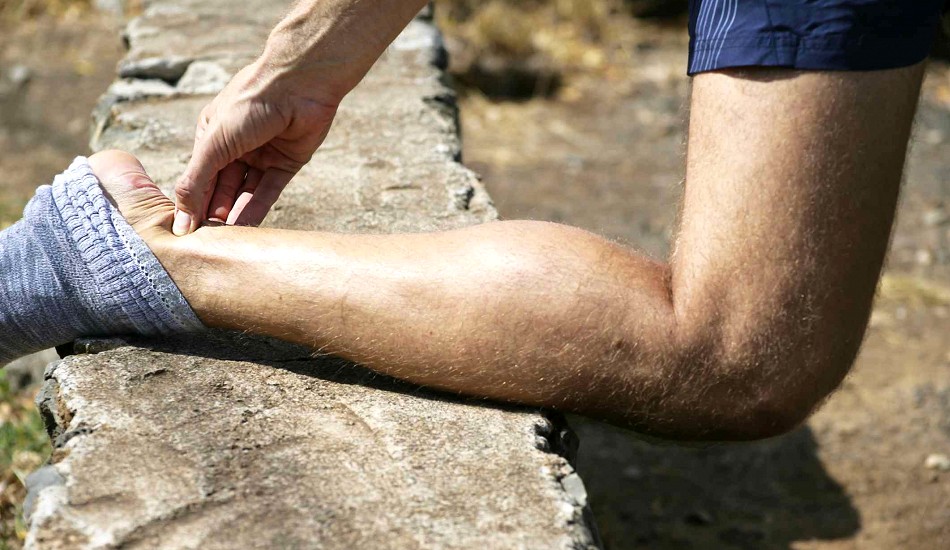
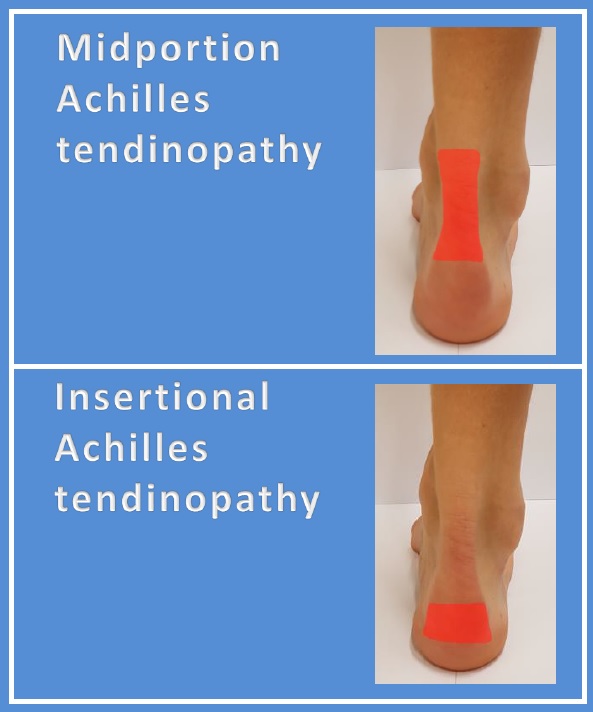
Typically, people with Achilles tendinopathy suffer from pain or stiffness in the achilles 2-7cm above the heel. It is commonly experienced in the morning or after prolonged sitting, and is worse with or after activities, although it may persist during rest. Less commonly, some may describe similar symptoms with point tenderness over the insertion of the Achilles on the calcaneus (i.e. heel).
Oh wait, I can experience pain in different areas of my Achilles tendon?? How am I supposed to differentiate them?!
Yes, Achilles Tendinopathy (previously known as Achilles tendinitis) is seen most commonly in the mid‐portion of the tendon, but also occurs at the bone-tendon junction.
Diagnostic criterias for Achilles tendinopathy
Note: This should only be used as a guide and we strongly urge that you seek proper assessment and advice from a trained Physiotherapist if possible.
🦵 Mid-portion tendinopathy:
Symptoms are localised to 2–7 cm above the AT insertion on the heel.
Pain at the midportion of the AT on loading (i.e. during sports).
Local thickening of the midportion of the AT (may be absent in cases where symptoms are short-lived).
Pain at the midportion of the AT on touch.
🦵 Insertional tendinopathy (i.e. at the bone–tendon junction):
Symptoms are localised (within 2 cm) to the region where the AT inserts onto the heel (i.e. insertional region).
Pain at the insertional region of the AT on loading (i.e. during sports).
Local thickening of the AT insertion (may be absent in cases where symptoms are short-lived).
Pain at the insertional region of the AT on touch.
Hmm…will I need a scan to double/ triple confirm?
No additional imaging studies are needed if the presenting case fits all four diagnostic criteria listed above. Achilles tendinopathy can typically be diagnosed based on a clinical criteria.
🔍Additional imaging studies may be needed if:
Your symptoms do not fit with all four of the above diagnostic criterias.
There is an unexpected course or change in symptoms during follow-up.
You are considering surgery.
Should I cease all activities and wait? 🤭
I know what you are thinking…but the short answer is NO🙅🏻♀️
It was found that no or limited improvements are expected in the short term as a result of a wait-and-see approach for those with long-standing Achilles tendinopathy.
How can Physiotherapy help with my Achilles pain?
According to a recent consensus statement, conservative treatment is usually the first choice for AT and active treatment is highly recommended! Hence, it is paramount for you to be assessed and treated by a trained Physiotherapist.
Inevitably, injured tendons lose their capacity to withstand forces. With the help of Physiotherapists at PhysioX, we are able to assess, differentiate and diagnose your Achilles pain. We will then be able to devise a treatment plan for the rehabilitation of your tendon so it can withstand high repetitive loads again!
Your Physiotherapist will also help to explain your condition and give you advice on lifestyle load management, especially for pain provoking activities. You will also receive a customized rehabilitation program that is tailored for your individual needs.
Will I ever recover?? How long will it take? 😞
Truth be told, although the majority of patients recover, there is a chance that your symptoms may persist (up to 10 years) in the long term despite treatment. Till date, there is insufficient knowledge about the exact prognosis.
👍🏻As a rule of thumb, a return to full symptom-free loading (during sports) is only possible after a few months (minimum) of active treatment.
Once your symptoms and condition improves, it is important to prevent recurrence. Notably, there is strong evidence that a history of tendinopathy in your lower limb is a risk factor for developing Achilles tendinopathy, with the likelihood of recurrent symptoms.
☝🏻Take note! For those who are becoming more active or looking to increase their training load, a gradual training program is important. This incremental loading process includes the type, frequency, size and intensity of training.
Continual exercise therapy for the calf muscles should be considered after symptomatic recovery from Achilles tendinopathy. For insertional Achilles tendinopathy, consider performing exercises on a flat surface initially.
The following is a flow chart depicting the proposed recommendations for a 12-week progressive calf muscle strengthening and explosive-type (i.e. plyometric) exercise program:
☝🏻You should only consider surgery if you do not recover after at least six months of active treatment.
Now that you know about your Achilles Heel (sorry I meant Achilles tendon pain), here are some exercises you can do for your rehab!
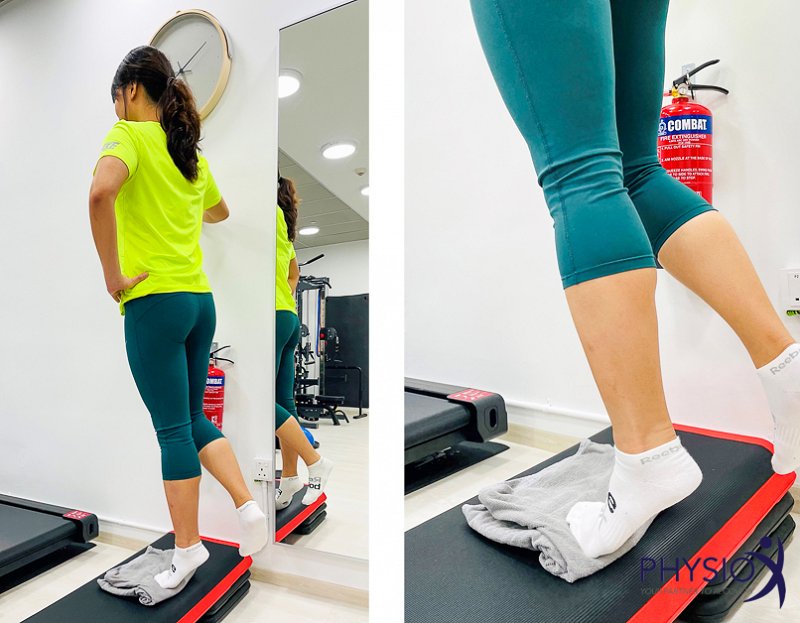
Heel raises with big toe over towel
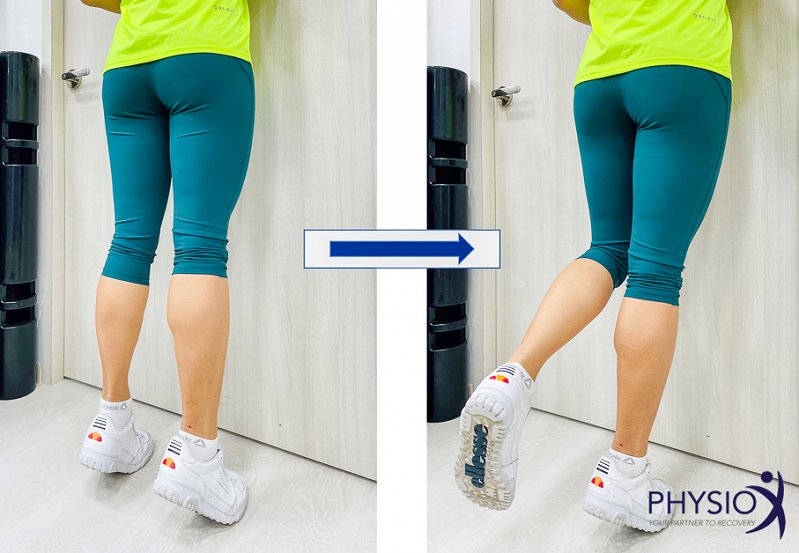
Heel raise & progression
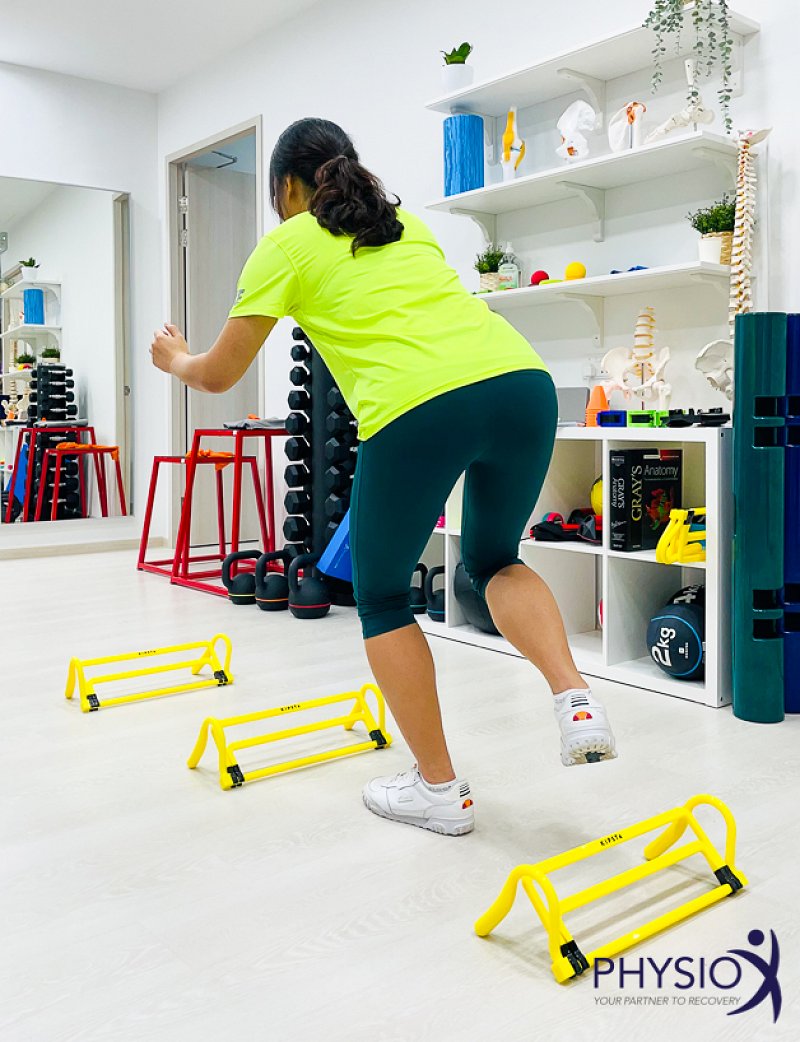
Single leg hurdle hops
Book now or give us a call to schedule an appointment to see our Physiotherapist who will be able to partner you to recovery as we address your achilles tendon pain!
DISCLAIMER: These advice and exercises should not replace the need for a consultation with a Physiotherapist especially if your condition doesn’t improve. Therapeutic exercise should be carefully selected to suit your condition.
Ref:
Bjsm, B. J. of S. M. (2020, August 10). Which treatment is most effective for Achilles tendinopathy? A new way of finding out! BJSM blog – social media’s leading SEM voice. https://blogs.bmj.com/bjsm/2020/08/10/which-treatment-is-most-effective-for-achilles-tendinopathy-a-new-way-of-finding-out/.
Asplund, C. A., & Best, T. M. (2013). Achilles tendon disorders. Bmj, 346.
de Vos, R. J., van der Vlist, A. C., Zwerver, J., Meuffels, D. E., Smithuis, F., van Ingen, R., … & Weir, A. (2021). Dutch multidisciplinary guideline on Achilles tendinopathy. British journal of sports medicine.
Malliaras, P., Palomino, J. R., & Barton, C. J. (2018). Infographic. Achilles and patellar tendinopathy rehabilitation: strive to implement loading principles not recipes. British journal of sports medicine, 52(19), 1232-1233.
Van Der Vlist, A. C., Winters, M., Weir, A., Ardern, C. L., Welton, N. J., Caldwell, D. M., … & De Vos, R. J. (2021). Which treatment is most effective for patients with Achilles tendinopathy? A living systematic review with network meta-analysis of 29 randomised controlled trials. British journal of sports medicine, 55(5), 249-256.
Filed under: Ankle