Key points
- Lateral elbow tendinopathy (LET), commonly known as tennis elbow, causes pain outside the elbow and often affects people who use their hands and wrists repetitively.
- Physiotherapy, including exercises and hands-on treatments, helps reduce pain, restore function, and improve strength for those with LET.
- Treatment strategies include exercises for wrist extensors, manual therapy, dry needling, taping, and in some cases, cryotherapy and ergonomics.
- Clinical implication: Following evidence-based approaches in Physiotherapy leads to better, longer-lasting pain relief and function in patients with lateral elbow tendinopathy.
- Study limitation: Research has not established the best combination or dose of treatments for all patients, and long-term outcomes of some therapies remain unclear.
- Patient implication: People with LET can expect relief and improved function when actively engaging in Physiotherapy, but recovery may require patience and a mix of approaches.
Understanding lateral elbow tendinopathy and its impact
Lateral elbow tendinopathy, more commonly known as tennis elbow, is a condition causing pain around the outside of the elbow. Despite its name, most sufferers have never played tennis. The condition is caused by overuse, usually from repetitive hand, wrist, or arm movements. In Singapore, where many people work with computers, tools, or manual labour, this condition is seen in office workers, tradespeople, cleaners, and recreational athletes.
The pain is usually found where the tendons from the forearm muscles attach to the bony bump on the outside of the elbow. Sometimes the pain can travel down the forearm. This pain can stop people from performing daily tasks such as gripping, lifting, or using their hands.
Any task that involves repetitive wrist extension, forearm twisting, or heavy use of the hands can cause microscopic damage and irritation to the tendon. If these activities continue, the body cannot repair the tendon tissue fast enough, and the pain and weakness can worsen. This leads to lateral elbow tendinopathy, which doctors and Physiotherapists are seeing more of in active and working adults in Singapore.
The clinical course of lateral elbow tendinopathy varies. Some people feel better in a few weeks, while others have symptoms for months or even longer. Up to 55% of people have lingering pain and loss of function more than two years after the first symptom, especially if their work or hobbies repeatedly stress the area. Even with treatment, some people experience recurrences or flare-ups.
Key symptoms and diagnosis methods
Most patients would experience lateral elbow tendinopathy by noticing soreness or a burning sensation around the outside of the elbow, especially when gripping, lifting, or twisting. The pain may increase with wrist extension movements—such as pouring, typing, or shaking hands. Weak grip strength is also common.
A key part of diagnosing lateral elbow tendinopathy is a clinical assessment. A physiotherapist or doctor will consider the patient’s history, the pattern of pain, and which activities trigger symptoms. They may perform specific tests that ask the patient to resist extension of the wrist or middle finger. These tests often reproduce the familiar pain. Sometimes, if the symptoms are unclear or there might be another cause of pain, imaging such as ultrasound or MRI may be suggested.
Common physical tests used in diagnosis include:
- Resisted middle finger extension test (Maudsley’s Test): The physiotherapist asks the patient to extend their middle finger against resistance. A positive test is pain at the elbow.
- Resisted wrist extension test (Cozen’s Test): The patient tries to extend their wrist while the therapist applies resistance. Pain at the elbow means the test is positive.
- Mill’s stretch test: The therapist stretches the wrist and elbow, and pain at the outside of the elbow suggests LET.
Clinicians often use questionnaires such as the Patient-Rated Tennis Elbow Evaluation (PRTEE) or Disabilities of the Arm, Shoulder, and Hand (DASH) to measure pain and disability. These are valuable in understanding how much daily activities are affected.
Who gets tennis elbow and why?
Whilst many assume only tennis players suffer from tennis elbow, anyone performing repetitive tasks can develop this pain. The highest risks are among people aged 40 to 60 years old, but anyone who overuses their wrist and hand muscles can get it.
Risk factors include:
- Repetitive hand, wrist, or forearm motions for more than two hours daily, especially over many years.
- Jobs involving frequent heavy lifting (over 20kg).
- Handling tools weighing more than 1kg, especially for women.
- Repetitive or heavy manual labour.
- Limited job control and low social support at work.
- Activities with much twisting or screwing movements.
Non-modifiable risk factors include being female, having the dominant arm affected, or a history of smoking. Some medical conditions that affect tendons and nerves (like rotator cuff injuries, carpal tunnel syndrome) also increase risk.
Being aware of these risks is useful in Singapore, where computer and manual work is very common. Prevention and early intervention can stop a short episode from turning into a long-lasting or recurrent condition.
What happens inside the tendon?
Lateral elbow tendinopathy is not simply inflammation. Instead, the tendon develops small tears and degenerative changes because it cannot repair itself quickly enough. The blood supply to part of the tendon is poor, and repeated use leads to changes in collagen (the tendon’s main building block), new nerve growth, and sometimes a low-level inflammatory reaction.
Over time, these changes cause pain, weakness, and sometimes swelling. If not allowed to rest and recover, the damage can become chronic—and harder to reverse. Understanding this process helps Physiotherapists in Singapore teach patients why active Physiotherapy and gradual loading are important, rather than simply relying on rest or medication.
How does tennis elbow affect daily life?
Living with tennis elbow is frustrating. Simple activities such as shaking hands, writing, holding a coffee mug, opening a door, carrying groceries, or working on a laptop can become painful. The pain may start as a mild annoyance but can interfere with sleep, work, and leisure if left untreated.
In Singapore, where staying productive and independent is important, the impact on work and home life cannot be understated. Many patients worry about losing function in their hand and fear long-term disability. Prompt and effective rehabilitation is critical.
How Physiotherapists in Singapore assess function and severity
Physiotherapists use a mix of objective and subjective measures to understand the impact of lateral elbow tendinopathy. These measures track progress and guide treatment.
Key assessment tools include:
- Patient-rated Tennis Elbow Evaluation (PRTEE): A questionnaire that asks about pain and difficulty with daily activities—ranging from 0 to 100, where higher scores mean more problems.
- Disabilities of the Arm, Shoulder, and Hand (DASH): This broader survey asks about the whole upper limb and includes specific sections for work and sports activities.
- Patient-Specific Functional Scale (PSFS): The patient picks activities important to them and scores how much their elbow pain affects each.
- Pain-free grip strength: Using a hand-held dynamometer, the therapist measures how much force the patient can produce without pain.
- Pressure pain threshold: A specialised device applies pressure to the tendon to test pain sensitivity.
- Joint movement (range of motion): Wrist, elbow, and forearm movement are measured to spot stiffness or compensation.
Physiotherapists in Singapore ensure these measurements are completed at the start of therapy and after key points, like midway and on discharge. This helps patients and therapists visualise progress.
Treatment options for lateral elbow tendinopathy
Evidence-based strategies
Physiotherapy for LET relies on three main goals:
- Reduce pain and irritation
- Restore movement and load capacity
- Prevent recurrence
Let us look at the range of treatments used by Physiotherapists in PhysioX.
Exercise therapy
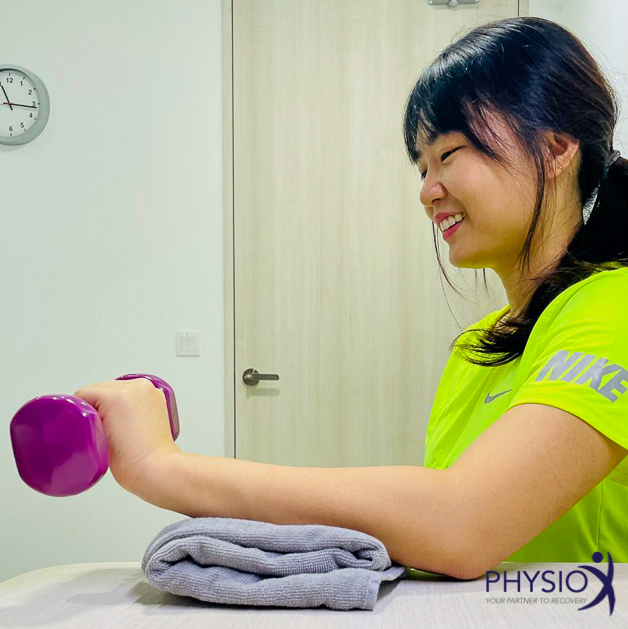
The foundation of physiotherapy for tennis elbow is a tailored exercise programme. Exercises aim to:
- Strengthen the wrist and forearm muscles, especially the wrist extensors.
- Improve flexibility and joint movement.
- Boost tendon healing by gradually loading the tissue.
Types of exercises recommended include:
- Isometric exercises: These involve squeezing or holding a weight still. They are gentle on the tendon in the early phase.
- Concentric exercises: These mean shortening the muscle, like lifting a weight.
- Eccentric exercises: These involve slowly lowering a weight, which challenges the tendon more and stimulates repair.
A typical prescription is 3 sets of 15 repetitions, progressing over 6 to 12 weeks as tolerated. Starting with low resistance and increasing gradually as pain decreases is vital.
A phased approach, advancing from simple to complex tasks as symptoms improve, helps prevent flare-ups and gets patients back to normal function. For those in high-demand jobs or sports, exercises also include movements up the arm (the “kinetic chain” approach) and later, more challenging exercises.
Manual therapy
Hands-on techniques, or manual therapy, include mobilisation and manipulation of the elbow and, sometimes, the wrist, cervical, or thoracic spine. Therapists use these techniques to:
- Reduce pain in the short term
- Improve movement
- Boost grip strength
Common manual therapy techniques are:
- Mobilisation with movement: The therapist gently moves the joint as the patient grips or performs a movement. It is proven to offer pain relief and strength gains immediately and after a few sessions.
At PhysioX, Physiotherapists combine these interventions with exercises and education for the best results.
Multimodal interventions
It is now normal to combine several approaches. A multimodal programme includes:
- Exercise (mainstay)
- Manual therapy for pain and movement
- Sometimes, additional strategies for stubborn symptoms
This combination gives the body its best chance to heal and the patient the skills to stay pain-free. Research shows that adding shoulder and scapular strengthening can help in patients with identified muscle weakness or poor posture.
Dry needling
Dry needling uses fine needles, inserted into tender points in the tendon or muscles, to reduce pain and improve function. Both tendon and trigger point dry needling have good supporting evidence for helping pain and function in lateral elbow tendinopathy.
Patients receiving dry needling report better pain relief over the medium term compared to steroid injections, with fewer side effects. When combined with exercise, it may speed recovery.
Soft tissue mobilisation
Applied manually or with instruments, soft tissue mobilisation targets tightness, scar tissue, or adhesions. It can:
- Reduce pain
- Improve movement and strength
- Aid healing in the tendon
Manual release therapy and instrument-assisted soft tissue mobilisation are used, often alongside exercise. Deep transverse friction massage has shown conflicting evidence and may not be much better than a placebo on its own.
Taping
Physiotherapists may use either rigid tape or elastic “kinesiology” tape. Taping aims for immediate pain reduction and improvement of muscle function. Rigid taping techniques, especially “diamond-deloading,” are effective for short-term relief. Kinesiology tape, as part of a broader programme, can offer short-term pain and function improvement. Adverse effects are rare, usually limited to mild skin irritation.
Orthoses (braces and supports)
Braces, such as a forearm counterforce strap or wrist support orthosis, may help. They are best used for immediate relief during activity, particularly when pain limits ability to work or play. They are not proven for long-term relief, but can allow patients in Singapore to stay active and productive during short bouts of pain.
Cryotherapy and electrophysical agents
Applying ice or cold packs can reduce pain, especially when paired with specific electrical stimulation (burst TENS), in the short term. There is no evidence for using heat alone. Therapists reserve these methods for highly irritable symptoms or flare-ups.
Ultrasound and phonophoresis
Ultrasound as a stand-alone treatment is not recommended due to conflicting results. Similarly, phonophoresis (ultrasound to drive anti-inflammatory drugs into the skin) is not effective for lateral elbow tendinopathy.
Iontophoresis
For very irritable, early-stage symptoms, iontophoresis with anti-inflammatories may help. This is a specialised approach and only for select cases.
Laser therapy
Laser may provide improvements in pain and grip strength at follow-up 4 weeks to 6 months later. However, it is not a staple of care due to limited research.
Ergonomics and patient education
Preventing recurrences is as important as treating pain. Clinicians in Singapore often focus on ergonomics and education. This means teaching patients how to set up workspaces (at home or office), change bad habits, and take regular breaks. Learning safe lifting, gripping, and wrist postures makes a difference in long-term outcome.
How long does it take to recover from tennis elbow pain?
For most people, tennis elbow improves over weeks to months. Some respond quickly, getting back to normal in a few weeks; others need several months of ongoing therapy and activity modification. Key factors that affect recovery include:
- Early start to evidence-based Physiotherapy
- Willingness to modify aggravating activities
- Regular performance of home exercises
- Avoidance of repetitive, heavy, or twisting movements during pain
- A positive attitude and patience
About 1 in 5 patients have ongoing or recurrent symptoms, which can be managed with a return to therapy and reactivation of the home exercise programme.
What should a patient expect in therapy?
Your Physiotherapist will perform an initial assessment, set tailored treatment goals, and involve the patient in each step. The journey typically includes:
- Education on the condition and its management
- Pain management strategies (manual therapy, taping, ice)
- Progressive exercises matched to symptom stage
- Ergonomic and posture advice for both work and leisure
- Monitoring of progress with regular measurements
Patients are empowered to take ownership of their recovery, and the physiotherapist is their guide, cheerleader, and expert support.
If symptoms are not improving, your physiotherapist may reassess and consider referring to a specialist for further investigations or other treatments.
Study limitation
While much is known, studies have not agreed upon the precise “best” combination of treatments, and it is unclear who will benefit most from each approach. Additionally, not all therapies have long-term data, and more research into patient subgroups is required.
Patient implication
If you suffer from lateral elbow tendinopathy in Singapore, know that recovery is possible. Working actively with your physiotherapist, performing home exercises, and making lifestyle adjustments yield the best results. Expect relief, but be patient and persistent, as improvement may take time and require different strategies.
References
Lucado, A. M., Day, J. M., Vincent, J. I., MacDermid, J. C., Fedorczyk, J., Grewal, R., & Martin, R. L. (2022). Lateral Elbow Pain and Muscle Function Impairments: Clinical Practice Guidelines. Journal of Orthopaedic & Sports Physiotherapy, 52(12), CPG1-CPG111. https://doi.org/10.2519/jospt.2022.0302
Lucado, A. M., Day, J. M., Vincent, J. I., et al. (2023). Physiotherapy for People with Lateral Elbow Tendinopathy: Using the Evidence to Guide Musculoskeletal Rehabilitation Clinical Practice. Journal of Orthopaedic & Sports Physiotherapy, 53(1), 5-6. https://doi.org/10.2519/jospt.2023.0501